If we review the current business landscape in 2026, we see that finding the best…
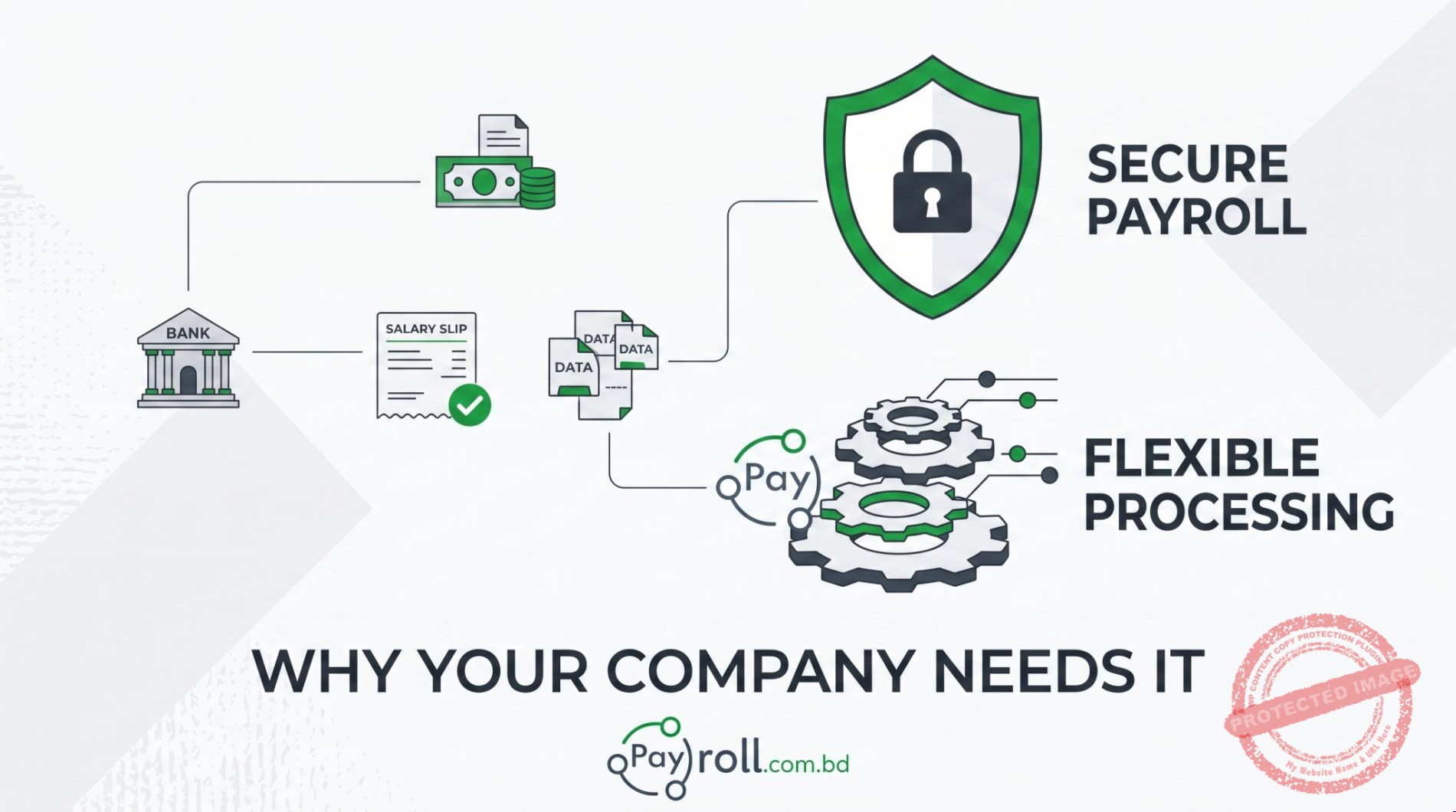
Why Does Your Company Need A Flexible, Secure Payroll Processing?
Executive Summary: Flexible & Secure Payroll Processing Architecture
Implementing a flexible and secure payroll processing system is essential for corporate governance and workforce satisfaction in Bangladesh. Consequently, modern enterprises must protect sensitive employee compensation data using advanced encryption while accommodating flexible salary structures and remote work arrangements. Furthermore, partnering with a certified payroll provider eliminates cybersecurity risks and ensures 100% NBR statutory tax compliance.
The Critical Need for Flexible & Secure Payroll Systems
Direct Answer / System Standard:
Specifically, a flexible and secure payroll processing system combines cloud scalability with enterprise-grade encryption to guarantee error-free salary disbursements and NBR tax compliance.
Specifically, a flexible and secure payroll processing system combines cloud scalability with enterprise-grade encryption to guarantee error-free salary disbursements and NBR tax compliance.
First, rapidly expanding commercial enterprises across Dhaka require resilient payroll infrastructure. For instance, businesses seeking complete processing reliability can explore our payroll processing solutions to automate monthly salary runs.
Second, foreign corporations deploying local staff can partner with our PEO services in Bangladesh or leverage our Employer of Record (EOR) service in Bangladesh for full statutory protection.
5 Essential Pillars of Flexible & Secure Payroll Architecture
Building a resilient payroll infrastructure requires incorporating five foundational technical pillars. Specifically, the five structured cards below detail these vital components.
Security & Flexibility Pillars
ENCRYPTION PILLAR 01
256-Bit Financial Data Encryption
Specifically, safeguarding employee bank account details and salary ledgers with bank-grade 256-bit SSL data encryption.
ROLE ACCESS 02
Role-Based Multi-Tiered Access Control
Furthermore, restricting payroll data visibility so regional HR managers only access information for authorized personnel.
CLOUD SCALABILITY 03
Scalable Cloud Payroll Infrastructure
In addition, accommodating rapid team expansion, hybrid working models, and multi-location office branches effortlessly.
NBR SAFEGUARDS 04
Automated Statutory NBR Tax Safeguards
Moreover, updating tax slabs automatically to ensure accurate Tax Deducted at Source (TDS) and provident fund withholdings.
DISASTER RECOVERY 05
Automated Cloud Data Backups & Disaster Recovery
Therefore, maintaining real-time automated off-site backups to prevent data loss during hardware failures or cyber incidents.
5-Step Security & Flexibility Implementation Roadmap
Upgrading your corporate payroll architecture requires following a disciplined five-stage roadmap. Specifically, enterprise HR and IT leaders should execute the five steps below.
Implementation Roadmap
SECURITY AUDIT 01
Conduct Comprehensive Payroll Security Audit
Specifically, evaluating existing spreadsheet workflows to identify security vulnerabilities and compliance gaps.
CLOUD INTEGRATION 02
Deploy Encrypted Cloud HRIS & Payroll Platform
Furthermore, migrating legacy payroll records onto a secure cloud platform with SSL encryption protocols.
MFA ENFORCEMENT 03
Enforce Multi-Factor Authentication & Role Permissions
In addition, requiring MFA logins for all HR administrators and assigning role-specific data access boundaries.
DEPOSIT TESTING 04
Execute Parallel Direct Deposit Testing
Moreover, running parallel salary disbursement runs to verify bank file transfers and electronic payslip generation.
CONTINUOUS AUDITING 05
Maintain Continuous Security & Compliance Monitoring
Therefore, performing periodic vulnerability scans and updating tax calculation modules in response to statutory changes.
Legacy On-Premise Payroll vs. Cloud Flexible & Secure Payroll Matrix
Comparing legacy manual spreadsheet processing with modern cloud payroll systems highlights critical operational upgrades. Specifically, the data table below contrasts key features.
Payroll Infrastructure Comparison
| System Feature | Legacy On-Premise / Spreadsheet Payroll | Cloud Flexible & Secure Payroll System |
|---|---|---|
| Data Encryption & Security | Specifically, unencrypted files vulnerable to unauthorized access & leaks. | 256-bit SSL encryption & multi-factor authentication. |
| Remote Workforce Flexibility | Furthermore, restricted office-only access creating processing delays. | 24/7 cloud access for global remote employee management. |
| NBR Tax Updates | In addition, manual tax formula updates prone to calculation errors. | Automated statutory tax bracket updates. |
| Disaster Recovery Speed | Moreover, high risk of complete data loss during hardware crashes. | Instant automated cloud backup and recovery. |
5 Key Business Benefits of Flexible & Secure Payroll Solutions
Adopting a flexible and secure payroll model provides substantial strategic benefits. Specifically, the five cards below detail these key advantages.
Business Benefits
ZERO BREACH 01
Elimination of Data Leakage & Cyber Breach Risks
Specifically, protecting confidential salary data from internal leaks and external cyber threats effectively.
REMOTE FLEXIBILITY 02
Seamless Payroll for Remote & Hybrid Workforces
Furthermore, enabling HR managers to process salaries remotely across multiple cities and time zones seamlessly.
PUNCTUAL DEPOSITS 03
100% On-Time Direct Deposit Salary Disbursements
In addition, ensuring 93%+ of employees receive accurate bank direct deposits on scheduled paydays.
NBR COMPLIANCE 04
Flawless Statutory NBR Tax Withholding
Moreover, filing Form 108 tax returns and employee TDS certificates accurately to eliminate penalty hazards.
EMPLOYEE MORALE 05
Enhanced Employee Trust & Organizational Morale
Therefore, fostering workforce trust through transparent electronic pay slips and reliable payroll execution.
Optimizing HR Solutions with Payroll.com.bd
First, company leaders seeking complete statutory rules can read our resource on must-know facts about payroll processing.
Resource Links & Service Comparisons
Second, corporate executives evaluating secure payroll options can review our detailed analysis on what are the best payroll services to make an optimal choice.
Frequently Asked Questions
Common Payroll Security Questions
Why is flexible and secure payroll processing essential for growing companies?
Specifically, flexible and secure payroll processing protects sensitive salary data, automates statutory NBR tax withholdings, and ensures punctual direct deposit salary payouts.
How does cloud-based payroll software protect financial data security?
Furthermore, cloud payroll systems utilize 256-bit SSL data encryption, multi-factor authentication (MFA), and role-based access controls to prevent unauthorized access.
What risks do companies face when using manual spreadsheet payrolls?
In addition, manual spreadsheet payrolls are vulnerable to data breaches, miscalculation errors, late NBR tax filings, and severe statutory penalty fines.
How does payroll outsourcing improve operational flexibility for remote teams?
Moreover, outsourcing enables seamless multi-currency payroll disbursements, time zone flexibility, and automated statutory compliance across global remote teams.
Related Posts