

Remote HR Manager Services in Bangladesh
A remote HR manager is a named person who runs your HR from our Dhaka desk: appointment papers, leave, files and the monthly people-questions, without a seat in your office. PayrollBD assigns the manager, holds the backup, and your team gets one person to ask.
What does the remote HR manager do?
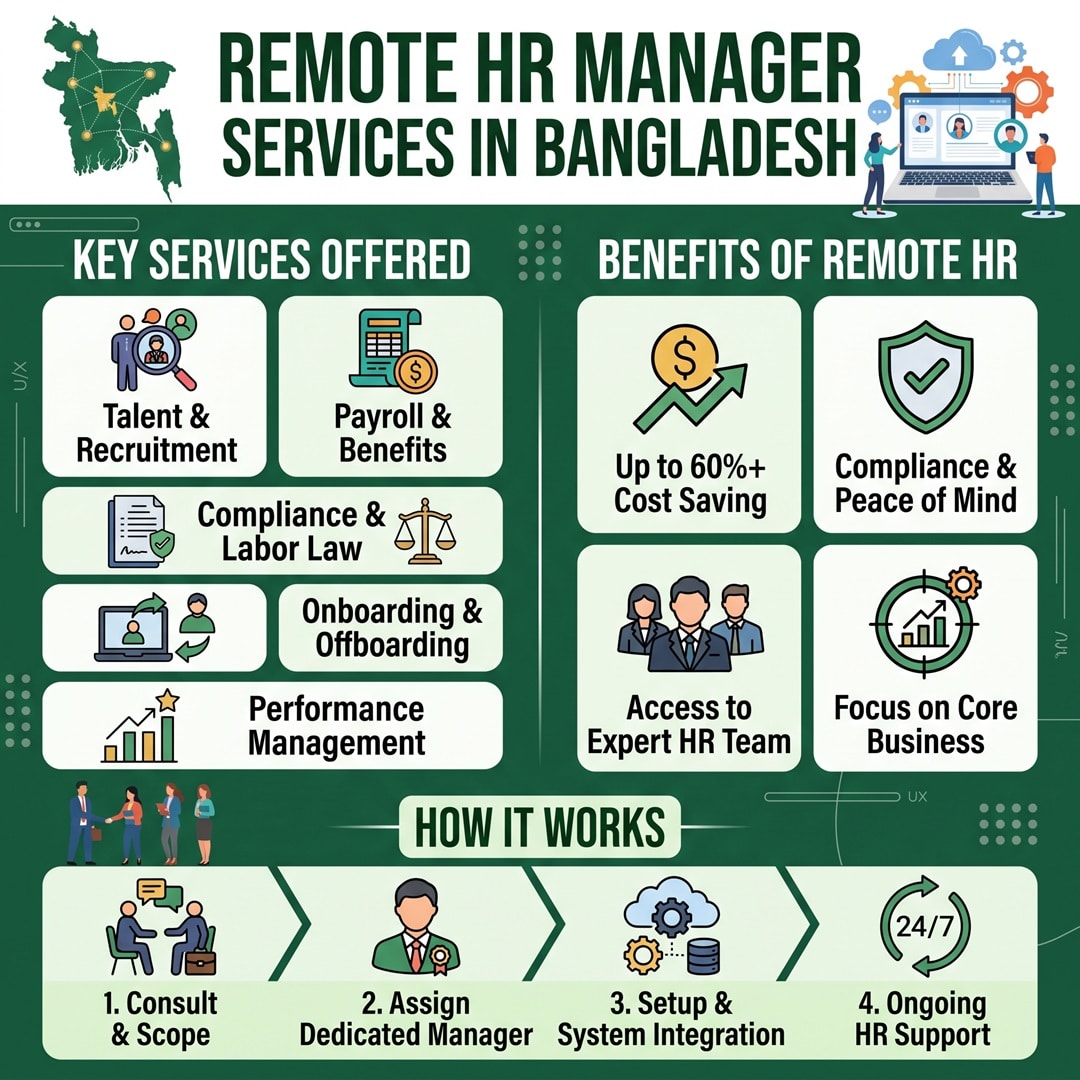
Six duties make up the manager’s month, and each one ends in a document your company keeps. The list runs from hiring support to policy work, and the split between what the manager does and what stays with your own team is written down at the scope, not assumed.
1. Recruitment: The manager runs your hiring rounds: briefs, shortlists, interviews arranged, offers issued.
2. Papers: The manager writes the appointment letters, contracts and the identity card entries at hiring.
3. Leave: The manager takes applications, issues orders in the statutory window, keeps the balances.
4. Performance: The manager runs confirmations, reviews and increment paperwork on schedule.
5. Exits: The manager handles resignations, terminations and the full and final settlement file.
6. Policy: The manager keeps internal rules and statutory registers aligned with the Labour Act.
What do you actually get?
Two things, and they are different: a named manager who answers your team, and the desk behind that manager, which keeps the system, the registers and the cover when the manager is on leave. One without the other is either a freelancer or a call centre; the service is both together.


Which duties stay statutory?
Whoever manages your HR, four duties are fixed by statute rather than by preference, and they land on the employer. The table names each one with its provision, read today from the Act’s text before being printed, so the manager’s calendar starts from the law rather than from habit.
| Duty the manager carries | Its statutory moment | Provision |
|---|---|---|
| Appointment letter and photo identity card | Before work begins | Labour Act 2006, section 5 |
| Service book for every worker | At hiring, at the employer’s cost | Labour Act 2006, section 6 |
| Register of workers | Open to the Inspector in working hours | Labour Act 2006, section 9 |
| Order on a leave application | Within seven days, or two before the leave | Labour Act 2006, section 10 |
Section 5 of the Bangladesh Labour Act 2006 states that no employer shall employ any worker without giving such worker a letter of appointment, and that every such employed worker shall be provided with an identity card with photograph. Section 6 places a service book for every worker at the employer’s own cost, kept in the employer’s custody; section 9 requires a register of workers available to the Inspector at all times during working hours; and section 10 requires orders on a leave application within seven days, or two days before the leave begins, whichever is earlier. The Act is reproduced by the International Labour Organization, and these are the rows a remote manager files first. Reviewed by Eicra Binte Islam, HR Admin, PayrollBD.
How does the engagement start?
Five steps, and none of them is a leap: the manager is met before anything is signed, and the first month runs beside your own arrangement rather than instead of it. What changes hands is defined in writing at step one, so the start date never moves the goalposts.
- 1Scope in writing which HR duties move to the manager.
- 2Meet the manager and the desk that stands behind them.
- 3Hand over the files, registers and current balances.
- 4Run the first month beside your existing arrangement.
- 5Hold the monthly rhythm: duties done, summary signed.
Who does it fit, and who not?
The honest split: the service fits a company that has HR work every month but not enough to seat a full-time manager, and it does not fit every case. The two paragraphs below draw that line, and the pages for the neighbouring cases are linked where they fit better.
It fits a local company whose HR sits with an overloaded accountant or founder, and a foreign employer with staff in Bangladesh who needs the papers, leave and registers run to the Labour Act by someone inside the country. In both cases the manager is the single point your team asks, and the record behind the answers is kept current on the desk’s system.
It does not fit a company whose need is really one hiring round, which is cheaper as a single engagement under manpower recruitment, or one that wants staff employed by a provider, which is employer of record work. And where the whole HR desk should move rather than one manager’s hours, the human resource management page describes that service.
What gets asked before hiring one?
Four questions come up before nearly every engagement of a remote manager, and the fee question is answered the way we answer it in writing: by basis, not by a number on a page. Each answer opens with the position and names what is fixed at the scope.
How is the remote manager supervised?
By two lines at once. Inside PayrollBD, the desk reviews the manager’s files and registers every month, and a second person can step in on leave days without the record missing a beat. On your side, the manager works to the written scope and your sign-off, and the monthly summary shows what was done against it.
What hours does the manager keep?
The hours you agree at the scope, on Bangladesh working days. A small team usually takes a part-time band with fixed days; a larger one takes full days. What matters more than the count is that the hours are named in the agreement, so availability is a term, not a hope.
What does the service cost?
The fee follows three things: the hours band you take, your headcount, and how much of the statutory record the manager carries beside the day-to-day questions. A written quote against that scope comes before anything starts, and a change in hours later changes the fee by the same written route.
When is a remote manager the wrong choice?
When the work is not monthly. A single hiring push, a one-off policy rewrite or a disciplinary case is project work, priced and run as a project. And where your staff should be employed by the provider itself, that is a different legal arrangement, which we run separately as employer of record.
Put a named HR manager on your team
Send your headcount, where your HR sits today, and the hours you think you need. We come back with the scope we would run, the shape of the manager profile that fits it, and the written fee basis, before you commit to anything or meet anyone.