
PEO Services in Bangladesh
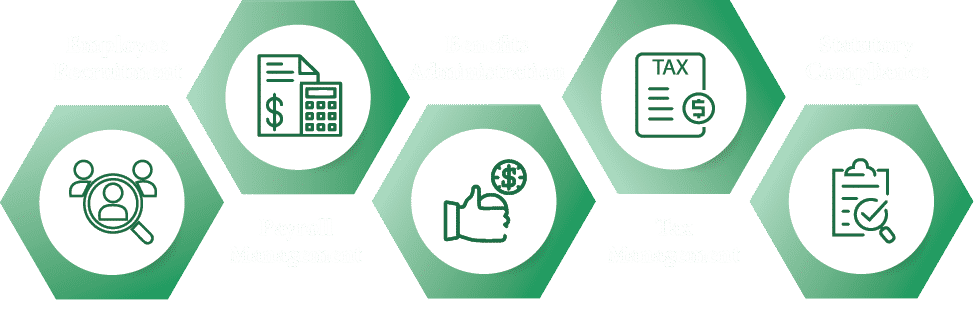
PayrollBD co-employs your Bangladesh team and runs the employment administration behind it. A PEO is an arrangement in which the provider handles payroll, HR records, onboarding, benefits and compliance while your company keeps the work, the hours, the pay and the performance. The employer role is shared, never handed over.
What are PEO services in Bangladesh?
PEO services in Bangladesh are the outsourced running of employment administration under a shared employer arrangement. The provider computes salaries, withholds tax at source, keeps the statutory employee records and files the monthly return. Your company decides what the people work on and what they are paid.
Nothing about the direction of the work moves to the provider, which is the point of the model. The arrangement suits a company that already holds, or is about to hold, its own Bangladesh entity. Where no entity exists, the companion service is employer of record, and the comparison further down sets out which one applies.
What is co-employment?
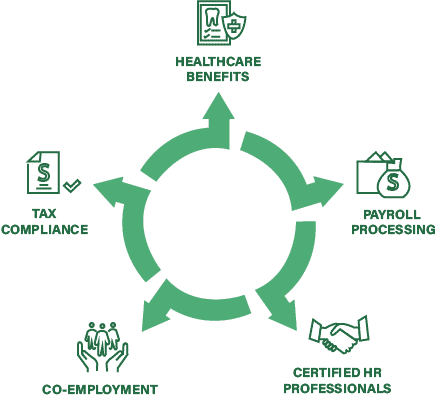
Co-employment splits the employer role in two. The administrative half sits with PayrollBD: payroll computation, tax deducted at source, employee records, benefits administration and the filing calendar. The directive half stays with you: what the work is, when it happens, what it pays and how it is reviewed.
Who Carries Which Duty?
The reason companies ask for this in writing is that Bangladeshi employment duties do not disappear when administration is outsourced; they move to a named party. The table sets out where each one sits under a co-employment arrangement, and what changes if the structure is an employer of record instead.
Read the row that matches your position, then check it against the entity you already hold. The definitions themselves sit in the Bangladesh Labour Act 2006 definition section, published by the Legislative and Parliamentary Affairs Division. Section 2(49) of the Bangladesh Labour Act 2006 treats the person given managerial responsibility in writing as the employer, so the split is agreed on paper before the first cycle rather than assumed afterwards.
| What differs | PEO co-employment | EOR employer of record |
|---|---|---|
| Your own Bangladesh entity | Generally needed | Not needed |
| Who legally employs the staff | Your company, role shared | The provider |
| Direction of the daily work | Your company | Your company |
| Payroll, records and filing | Handled by the provider | Handled by the provider |
| Written managerial responsibility | Assigned in the agreement | Held by the provider |
What Does The Service Include?
Six standing duties run every cycle, and each one produces a record your finance team can check. None of them is bundled into a vague retainer, and none is billed as an extra once the engagement is running. The list below is the whole scope of the administrative half, which is the half that moves to us under co-employment.







How does an engagement start?
Five stages, in this order, and the first two both happen before anyone is paid. The sequence exists because the written split of duties has to be settled before the employment relationship carries any obligation, not after it has already started. Companies that reverse those two steps are the ones who later find nobody agreed who was responsible for what.
- Tell us the shape of the team. You name the headcount, the roles and which parts of payroll and HR you want handled. We confirm whether co-employment fits or whether an employer of record is the correct structure.
- Agree the co-employment split. Contracts and terms are set out in writing, with each duty assigned to your company or to PayrollBD.
- Onboard the employees. Each hire is brought on with the contract, the joining documentation and the records an employer must keep.
- Run the cycle. We compute salaries, withhold tax at source, prepare the bank disbursement instruction and issue payslips.
- Report back. You receive the payroll register, the deduction record and the filing confirmation for the month.
How do PEO and EOR differ?
The difference is who legally employs the person, and it decides whether you need your own Bangladesh entity. Under co-employment the employer role is shared and your company normally holds an entity.
Under an employer of record the provider is the legal employer, so hiring can begin before incorporation or without it. The two are related, and they are routinely confused, but they are not interchangeable.
The exact structure depends on your arrangement and on the provisions of Bangladesh law that apply to it. Where the answer is not obvious from your entity position, we say which one fits before an agreement is drafted.

Who should use a PEO?
A PEO fits a company that wants a Bangladesh team without building a Bangladesh HR function to support it. Four situations account for most engagements, and each one shares the same shape: the work is clear, the administration behind it is not.
- Entering the market. A foreign company opening in Bangladesh that needs people working before it needs an HR department.
- A small local team. A headcount too small to justify a dedicated payroll and HR function of its own.
- Testing before committing. A company running a limited operation to see whether the market supports a larger one.
- Administration overload. A company whose managers are spending their week on paperwork rather than the work itself.
What if you have no entity yet?
This is the most common reason a PEO enquiry turns into something else. Co-employment assumes your company can hold the employer role alongside the provider, and holding that role generally means holding a Bangladesh entity. Without one, the model does not apply cleanly.
The structure that does apply is employer of record, where the provider is the legal employer and hiring can start before incorporation. Where the hire is a foreign national, the work permit route runs alongside it. Start with employer of record, or with work permit and E-visa processing if staff are arriving from abroad.
If you are not sure which side you fall on, the deciding fact is whether your company can hold the employer role in writing. Send us your entity position, or tell us you have none yet, and we will say which of the two structures applies before anything is drafted.
Where does co-employment not fit?
Co-employment fails on structure far more often than on service. The first failure is a company with no Bangladesh entity signing a PEO agreement that assumes one, which leaves the employer role unassigned.
The second is treating the split as understood rather than written, when section 2(49) of the Bangladesh Labour Act 2006 makes the written assignment of managerial responsibility the deciding fact. The third is assuming the arrangement covers tax owed by an employee in another country of residence, which it does not.
The filing calendar is the part clients most often underestimate. Section 177 of the Income Tax Act 2023 sets the withholding return at the fifteenth of the month following, and where the fifteenth is a holiday it falls to the next working day. The provision is published in the Income Tax Act 2023 return of withholding tax section.
| What falls due | When it falls due | Where it goes |
|---|---|---|
| Salary disbursement | The cycle date set in your engagement | Your own bank account |
| Tax deducted at source | Withheld before the salary is released | Held against the monthly return |
| Monthly withholding return | The fifteenth of the following month | National Board of Revenue |
| Work permit application | Within fifteen days of a foreign hire arriving | Bangladesh Investment Development Authority |
Two of these dates are fixed by rule rather than by agreement, so they are the two worth putting in a calendar. The other two follow your own cycle.
Each cycle hands back these records.
- Payroll register showing gross, deductions and net for every employee in the cycle.
- Deduction record for the tax withheld at source, against each employee file.
- Disbursement instruction prepared in your bank’s format for your authorised signatory.
- Employee documentation file holding contracts, leave and attendance for the period.
- Filing confirmation for the monthly withholding return submitted under section 177.
What do buyers ask first?
These four questions come up before nearly every engagement, and they come up in this order. Each answer states the position first and then explains it, rather than the other way round. Where a provision of Bangladesh law governs the point, the section is named so you can check it against the source rather than take our word for it.
What is a PEO in Bangladesh?
A PEO, or professional employer organisation, co-employs your staff in Bangladesh and runs the employment administration. That covers payroll, HR paperwork, onboarding, benefits administration and compliance support. You keep control of the work itself, the hours, the pay and the performance review. The arrangement is called co-employment because the employer role is shared rather than transferred.
How does a PEO work in Bangladesh?
You direct your employees and PayrollBD runs the administration behind them. Each cycle we compute salaries, deduct tax at source, prepare the disbursement instruction for your bank and keep the statutory records.
Section 177 of the Income Tax Act 2023 requires the withholding return by the fifteenth of the following month, and that filing sits with us. You receive a reporting pack your finance team can reconcile.
What services does a PEO provide?
Payroll processing, employee onboarding, HR administration, benefits administration, employment compliance support and workforce management. The compliance side covers tax deducted at source and the employee records Bangladesh law requires an employer to keep. What a PEO does not do is take over the legal employer role. That is the boundary between a PEO and an employer of record.
What is the difference between PEO and EOR?
The difference is who legally employs the person. Under a PEO the employer role is shared and your company normally holds its own Bangladesh entity. Under an employer of record the provider is the legal employer, so you can hire before you incorporate or without incorporating at all.
Section 2(49) of the Bangladesh Labour Act 2006 treats the person given written managerial responsibility as the employer, which is why the structure has to be set out in writing.
Ready to build your team in Bangladesh?
Tell us the headcount, the roles and which duties you want handled. We confirm whether co-employment or employer of record is the correct structure for your entity position, then set the split of responsibilities out in writing before anyone is onboarded.
Where the answer is employer of record rather than a PEO, we say so at that point rather than after an agreement is signed.