

Remote Office and Offshore Staffing in Bangladesh
A remote office in Bangladesh is a dedicated team that PayrollBD recruits, employs and seats in its Dhaka office to work only for your company. You choose the people, set the hours of overlap and direct the work on your own tools. PayrollBD carries the employment, the payroll, the desks and the devices, and bills one invoice a month per seat.

What is a remote office in Bangladesh?
A remote office is a team of your own people, working only for you, seated and employed by PayrollBD in Dhaka. It is not a virtual office, which gives you an address and mail handling but no staff. It is not an employer of record arrangement alone, which employs people you found and seats them wherever they are.
PayrollBD finds the people with you, employs them under the Bangladesh Labour Act 2006, gives them a desk, a device and connectivity, and runs their payroll, leave and holidays. You interview and choose each hire, set the shift, and manage the work on your own tools. The team reports to your manager, not to ours.
The cost of a seat is quoted per person, in writing, as one monthly figure. It moves only when the headcount, the role or the hours change, and every change is agreed before it is billed.
Who is a remote team for?
Three kinds of buyer, each with a different first question. The company with no Bangladesh entity asks who the employer is. The firm scaling a delivery team asks how fast seats can be added. The group moving back-office work asks how the handover is sequenced. The three below are answered in that order, and the offshore project management page covers delivery run by PayrollBD managers rather than yours.
- No entity in BangladeshA foreign company that wants a team in Dhaka without registering a company, renting an office or running a local payroll of its own.
- Scaling a delivery teamA software, data or design firm adding seats faster than it can hire at home, with the team working on its tools and under its managers.
- Moving back-office workA group moving finance, support or research desks offshore, with the work handed over role by role rather than all at once.
What does PayrollBD commit to for every seat?
Four commitments, each a boundary you can check against the papers rather than a promise. They cover who employs the team, who directs the work and owns it, how the cost is billed, and what happens to the people and your data when a seat ends. Each is written into the terms before the first hire.
How does the remote office start?
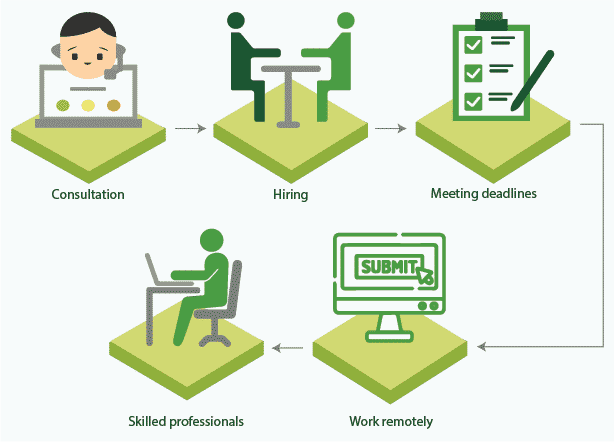
Eight steps from the first brief to the first shift, in the order they happen. The first two are paper: the roles and the written terms. The next three are people and desks. The last three are the monthly routine that keeps the team running and lets it grow or shrink on notice. The second tab names the kinds of team most often built this way.
Eight steps, then the team types
The steps run left to right and top to bottom, four on each side. A step is not skipped to save time: the appointment letter in step four exists because the Act requires it, and the terms in step two exist because every later question about ownership, notice and overtime is answered there rather than argued later.
Steps one to four sit in the left box and five to eight in the right. Nothing in the right box begins until the appointment letters in step four have been issued, because a person on a desk without the papers the Act names is a liability you would carry without knowing it.
- 1Send the roles, the headcount and the hours of overlap you need with your own team.
- 2Agree the written terms: seat fee, notice, confidentiality and ownership of work and data.
- 3PayrollBD advertises, screens and shortlists. You interview and choose each person.
- 4Each hire receives a PayrollBD appointment letter and identity card under section 5 of the Act.
- 5Desks, devices, connectivity and your access controls are set up in the Dhaka office.
- 6The team starts on the agreed shift, reporting to your manager on your own tools.
- 7Payroll, leave, holidays and overtime are run each month and billed on one invoice.
- 8Headcount is added, replaced or reduced on the notice the written terms set.
Five kinds of team are built most often, and each works inside your own systems rather than on a platform of ours. The label on each card is the team, and the line beside it names the tools and the reporting line, because those two things decide whether a remote seat works or merely exists.
- Software and productDevelopers, testers and designers working inside your repositories and sprint tools, on your release calendar.
- Finance and back officeBookkeepers, payables clerks and reconciliation staff working in your ledger under your controls.
- Customer support deskChat, email and ticket agents on your helpdesk platform, scheduled to the hours your customers keep.
- Data and researchAnalysts, annotators and researchers producing datasets and reports to a written specification.
- Sales developmentOutbound and inbound representatives working your CRM, booking meetings for your own closers.
Which services sit around the team?
Three groups of work run behind every seat, and all three are included in the monthly figure rather than billed separately. The first is the employment itself. The second is the physical workspace and the equipment. The third is the hiring at the start and the exit at the end, which are the two moments most offshore arrangements handle badly.
Employment and payroll
The team is employed by PayrollBD from the first day, with the papers section 5 of the Labour Act names and the monthly payroll that follows. Tax deducted at source and provident fund contributions are handled with the payroll run, and every record is kept per person.
Appointment letters, identity cards and personnel files.
Monthly payroll, tax deducted at source and provident fund.
Leave, holiday and overtime records per person.
Workspace and equipment
Each seat is a desk in the Dhaka office with power backup and connectivity, and a device issued and imaged to your standard. Access is granted through your own controls, so a person sees only what you allow, and the device comes back to be wiped when the seat ends.
Desks in the Dhaka office with power backup.
Devices issued, imaged and returned on exit.
Connectivity and your own access controls.
Hiring and exit
Hiring runs through advertising, screening and shortlisting with the recruitment team, and you interview and choose. When a person leaves, a replacement is hired on the same brief. When a seat ends, the written notice runs and PayrollBD carries the separation.
Advertising, screening and shortlisting for each role.
Replacement hiring when a person leaves.
Separation or redeployment on the written notice.
Which duties does the employer carry?
Because PayrollBD is the employer, the duties of the Bangladesh Labour Act 2006 fall on PayrollBD, not on you. The table names the five that shape a remote team day to day, with the section that creates each duty and what the team receives under it. The paragraph beneath names the text the sections were read from.
| Employer duty | Labour Act section | What the remote team receives |
|---|---|---|
| Letter of appointment and identity card | Section 5 | A PayrollBD appointment letter and photo identity card for every person |
| Daily and weekly hours | Sections 100 and 102 | Shifts set inside the statutory caps, with your overlap fixed in writing |
| Weekly holiday and festival holiday | Sections 103 and 118 | A rest day each week and the Bangladesh public holidays, scheduled against your calendar |
| Extra allowance for overtime | Section 108 | Extra hours paid at the section’s rate and billed as a separate line |
| Casual, sick and annual leave | Sections 115, 116 and 117 | Leave accrued and recorded per person, with cover arranged for planned absence |
The Bangladesh Labour Act 2006, Act No. XLII of 2006, is published by the Laws of Bangladesh site and in an English text hosted by the International Labour Organization. Section 5 provides that no employer shall employ any worker without giving such worker a letter of appointment, and that every such employed worker shall be provided with an identity card with photograph. Chapter IX of the Act, Working Hours and Leave, carries section 100 on daily hours, section 102 on weekly hours, section 103 on the weekly holiday, section 106 on night shift, section 108 on the extra allowance for work overtime, sections 115 to 117 on casual, sick and annual leave, and section 118 on festival holiday. Sections 26 and 27 govern termination of employment by employers and by workers. Reviewed by Eicra Binte Islam
What gets asked before a team is set up?
Four questions come up before nearly every remote office: who the legal employer is, how the monthly fee is built, whether the team can keep your hours, and what happens to the people and the data when the arrangement ends. Each is answered below, and each answer names the section of the Act or the clause of the terms it rests on.
Four answers, each with its source
Each answer opens with the position and then gives its basis: a section of the Bangladesh Labour Act 2006 read for this page, or a clause in the written terms every client signs. Where a point depends on the role, the salary or the hours, the answer says so instead of offering a figure that would not hold for every seat.
Who is the legal employer of the remote team?
PayrollBD is. Each person on your remote team holds a PayrollBD appointment letter and identity card, as section 5 of the Bangladesh Labour Act 2006 requires of every employer. Wages, leave, holidays and statutory records sit with PayrollBD as the employer. You direct the work, set the priorities and review the output, and that division is written into the terms before the first hire, so no one is left unsure who answers for what.
How is the monthly fee for a remote seat set?
Per seat, in writing, before anyone is hired. The fee for a seat is built from the salary agreed with you for that role, the statutory employer costs that follow it, the desk, device and connectivity, and PayrollBD’s management fee. It is quoted as one monthly figure per person and billed on one invoice. No figure sits on this page because the salary line depends on the role and the market at the time of hiring.
Can the team work in our time zone?
Yes, within the hours the Labour Act allows. Daily and weekly hours are governed by sections 100 and 102, night work by section 106, and overtime by the extra allowance of section 108. The overlap you need with your own office is written into the terms, the shift is set inside those sections, and any hours beyond it are paid and billed as overtime rather than absorbed. A shift that cannot be run lawfully is not offered.
What happens to the people and the data if we stop?
The written terms say. Headcount is reduced on the notice period they set, and PayrollBD, as the employer, carries the separation under sections 26 and 27 of the Labour Act or redeploys the person to another client. Your accounts, devices and files are returned or wiped on a written confirmation, and every deliverable produced for you remains yours under the ownership clause signed at the start. Nothing of yours stays on a desk in Dhaka after the last day.
Send the roles you want to fill
Send the roles, the headcount, the hours of overlap you need and the tools the team will work in. We come back with a seat-by-seat cost built from the salary range for each role, the written terms covering notice, confidentiality and ownership, and the hiring calendar for the first seats, before anyone is advertised for.