

Financial Due Diligence for Safer Deal Decisions
Financial due diligence tells you what a target company is really worth before you buy, invest in or lend to it. PayrollBD examines the numbers behind the deal — earnings, assets, cash flow, tax and hidden liabilities — so corporate acquirers, private equity firms and lenders can price the transaction correctly and decide with confidence.
What does financial due diligence cover?
Financial due diligence (FDD) is a structured review of the numbers that decide a deal. We test a company’s reported profit, the quality of its assets, its cash flow and its accounting policies, so buyers, investors and lenders understand the risks and the real value before money changes hands.
The output is practical, not academic. You receive findings that map directly to the price you should pay, the way the transaction should be structured, and the protections you should ask for in the agreement.

Who do we run due diligence for?
Due diligence is not one-size-fits-all. A strategic buyer, a private equity fund, a lender and a seller each need a different question answered, so we scope the work around your role in the transaction rather than running a generic checklist. Choose your position below to see what the engagement delivers, which risks we prioritise, and how the findings feed the decision in front of you.
Choose your buyer type
Each tab below is written for one side of the table. Open the one that matches your role — acquirer, investor, lender or seller — to see the specific risks we test and the deliverable you receive at the end of the engagement.
You see the target’s real earnings before you commit.
- Quality-of-earnings and normalized EBITDA review.
- Working-capital and net-debt positions that adjust the price.
- Integration and synergy risks flagged early.
- Tax and contingent-liability exposure quantified.
You protect portfolio returns from the first day of ownership.
- Cash-flow durability and forecast stress-testing.
- Management reporting and KPI reliability checks.
- Add-on and buy-and-build risk mapping.
- Exit-readiness gaps identified upfront.
You lend against numbers you can actually trust.
- Debt-service capacity and covenant headroom.
- Asset quality and security-cover checks.
- Historical cash conversion and liquidity.
- Early-warning signs of financial distress.
You go to market with no surprises left in the data room.
- A vendor due diligence report buyers can rely on.
- Value drivers identified and ranked.
- Weak spots fixed before buyers find them.
- A defensible, well-supported asking price.
Why trust our due diligence team?
Plenty of firms can add up a set of accounts. What changes the outcome of a deal is judgement, independence and knowing where Bangladeshi numbers tend to hide risk. These four commitments describe how we work on every engagement, whichever side of the transaction you sit on.
Independence. Our findings answer to the evidence, not to the deal. You get an objective read on earnings, assets and risk, even when it complicates the transaction.
Confidentiality. Only senior, permanent specialists handle your data, and every engagement runs under a signed non-disclosure agreement.
Deal focus. Every finding is tied to something you can act on — the price, the structure, or a condition in the agreement.
Local insight. We read Bangladeshi accounts as they are actually kept, against RJSC records, NBR tax rules and IFRS as adopted in Bangladesh.


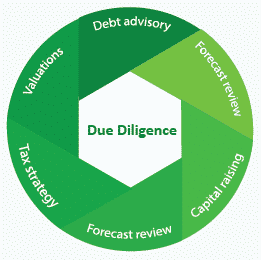
What core services does due diligence include?
Our financial due diligence brings together six core work-streams. Depending on the deal we run all of them or concentrate on the ones that carry the most risk, from valuation and quality of earnings through to debt, capital structure and tax. Each stream feeds a single, decision-ready report rather than a stack of disconnected spreadsheets, so you can act on what we find.
- Valuation of the target business.
- Acquisition and vendor due diligence.
- Independent accountant’s report and forecast reviews.
- Capital raisings.
- Debt advisory.
- Tax strategy and structure.
Quality-of-earnings and normalized EBITDA analysis.
Working-capital, net-debt and cash-flow review that moves the price.
Tax exposure tested against NBR income tax and VAT rules.
Contingent liabilities and off-balance-sheet items surfaced.
Accounting policies and internal controls assessed under BFRS.
How do sell-side and buy-side differ?
The same discipline works in both directions. Buy-side due diligence protects the acquirer by testing what drives the price and what could erode it after completion, and it links directly to our wider risk management services. Sell-side, or vendor, due diligence prepares the seller by finding and fixing weaknesses before buyers do, so the process runs faster and the asking price holds up under scrutiny.
| Focus | Buy-side | Sell-side |
|---|---|---|
| Who it protects | The acquirer or lender | The vendor or seller |
| Main question | What could erode value after completion? | What will buyers challenge on? |
| Key deliverable | Buy-side due diligence report | Vendor due diligence report |
| Best timing | Before signing or funding | Before going to market |


Which due diligence guides can help you?
Due diligence rewards preparation. On request we share short reference notes covering how a review is scoped, what a quality-of-earnings analysis looks at, and how buy-side and sell-side work differs. You can also explore the related services we run across risk and investment advisory:
Financial risk management
Business investment advisory
What do clients ask about due diligence?
Most questions about financial due diligence come down to scope, confidentiality, timing and who carries the risk. The answers below set out how we handle each one, in plain terms, so you know exactly what to expect before you engage us on a transaction.
Reviewed by Eicra Binte Islam
What does financial due diligence include?
Financial due diligence reviews a target company’s real financial position before you transact. We examine quality of earnings, assets and liabilities, historical cash flow, accounting policies and internal controls, and tax exposure, then report the risks and opportunities that affect your price and structure.
How long does a due diligence review take?
It depends on the size of the deal and how ready the data room is. We agree a timeline with you at kickoff and flag early if missing information is likely to move that date; we do not quote a fixed number of days before we have seen the scope.
How do you keep our deal information confidential?
Only our senior, permanent specialists access your information, and both they and the firm sign a confidentiality agreement before work begins. Deal data is never shared outside the engagement team.
Who is responsible for the investment decision?
You are. We give you an independent, evidence-based view of the numbers and the risks; the decision to proceed, renegotiate or walk away remains yours. Our role is to make sure that decision is well informed.
Can you review companies outside Bangladesh?
Yes. Our headquarters are in Bangladesh, and we work through online operations and local agents in other markets, so cross-border targets can be covered within one engagement.
Can you tell a target’s real profitability?
Yes, within the limits of the data provided. We rebuild reported profit into a quality-of-earnings view, stripping out one-off, non-recurring and related-party items so you see the earnings the business actually sustains.
What happens after we send an enquiry?
After you enquire, we move through a short, defined sequence before any report is written.
- We hold a short scoping call to understand the deal and your concerns.
- We agree the scope, timeline and a confidentiality agreement.
- We issue a data request and review what the data room provides.
- We analyze the findings and raise follow-up questions.
- We deliver a report tied to price, structure and risk, and talk you through it.
Can you take over from another advisor mid-deal?
Yes. We can pick up an engagement in progress, review what has been done so far, and focus our work on the open questions that still carry risk, so you do not pay twice for the same analysis.
What are the limits of a due diligence review?
Due diligence reduces risk; it does not remove it. Our findings are based on the information made available to us within the agreed scope and timeline, and a due diligence review is not a statutory audit or a guarantee of future performance.
Protect your deal from costly surprises
A weak deal rarely announces itself; it shows up later as a price you overpaid or a liability you inherited. A focused financial due diligence review is the cheapest insurance against that, and the first step is a short, no-obligation conversation about your transaction.